- Welcome
- Admission
- Academics
- Academic Calendar
- Arrival of Freshmen and Provision of accommodation
- Arrival of old students and provision of accommodation
- Checking of Final year students results by Heads of Department
- Christmas break
- Departmental Examinations
- Departmental Examinations begin
- Departmental Examinations end
- End of First Semester. Students Vacate Campus Easter Break
- End of Session. Students Vacate Campus
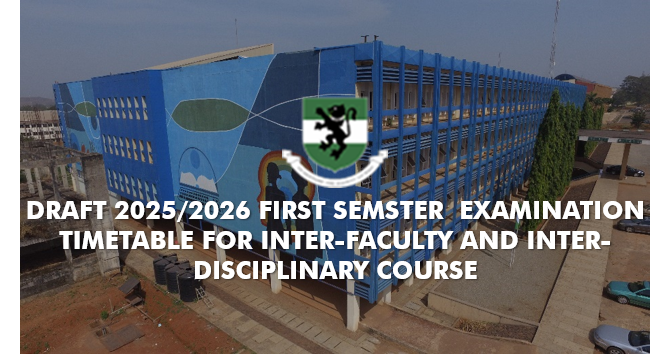
- Examination for Inter-Faculty and Inter-Disciplinary Courses
- Examinations in Inter-Faculty and Inter-Disciplinary Courses begin
- Examinations in Inter-Faculty and Inter-Disciplinary Courses end
- Faculty Boards meet to consider and approve Final Year students’ results
- Last date for submission of Final Year results to the Department and Processing Of Final Year results begins in December
- Last date for the submission of Final Year students’ results to the Registry (Examinations)
- Late registration begins
- Late registration ends
- Late registration ends for Freshmen
- Lectures begin
- Lectures end
- Lectures in progress
- Orientation of Freshmen begins
- Processing of Final Year students’ results ends in the Department
- Registration begins
- Registration begins for Freshmen
- Registration ends
- Senate meets to consider and approve Final Year students results
- Session Begins
- Students return to campus
- Teaching & Learning
- Academic Programmes
- Schools & Faculties
- Medical Sciences & Dentistry
- Anatomy
- Anesthesia
- Chemical Pathology
- Community Medicine
- Dermatology
- Hematology and Immunology
- Medical Microbiology
- Medical Biochemistry
- Medicine
- Morbid Anatomy
- Obstetrics and Gynecology
- Ophthalmology
- Otolaryngology
- Pediatrics
- Pharmacology and Therapeutics
- Physiology
- Psychological Medicine
- Radiation Medicine
- Surgery
- Medical Sciences Staff List
- Pharmaceutical Sciences
- Physical Sciences
- Post Graduate Studies
- Social Sciences
- Veterinary Medicine
- Animal Health and Production
- Veterinary Anatomy
- Veterinary Medicine
- Veterinary Obstetrics and Reproductive Diseases
- Veterinary Parasitology and Entomology
- Veterinary Pathology and Microbiology
- Veterinary Physiology/Pharmacology
- Veterinary Public Health and Preventive Medicine
- Veterinary Surgery
- Veterinary Teaching Hospital
- Faculty of Vet Medicine Staff List
- Environmental Studies
- Agriculture
- Arts
- Biological Sciences
- Business Administration
- Dentistry
- Education
- Engineering
- General Studies
- Health Sciences & Technology
- Health Administration and Management
- Medical Laboratory Sciences
- Medical Radiography and Radiological Sciences
- Medical Rehabilitation
- Nursing Sciences
- A SURVEY ON METHODS OF WEIGHT CONTROL AMONG FEMALE UNDERGRADUATE STUDENTS IN UNIVERSITY OF NIGERIA, ENUGU-CAMPUS
- ATTAINING GLOBAL SOCIAL INTEGRATION AND EQUITY THROUGH SPORTS FOR ALL
- Department of Medical Rehabilitation
- Faculty of Health Sciences Staff List
- Mr. Canice Chukwudi Anyachukwu
- THE RELATIONSHIP BETWEEN LIFESTYLES AND THE BODY MASS INDEX OF EXECUTIVES OFFCERS
- Law
- Medical Sciences & Dentistry
- Institutes
- University Campuses
- University Libraries
- Graduation Requirements
- Academic Calendar
- Innovation
- Life on Campus
- About the University
- Vision, Mission and Core Values
- From the Vice Chancellor
- Founding the University
- Through the years
- The University Lands
- Visitor Information
- Heroes
- Support Services Units
- School Anthem
- Office of the VC
- Testimonials
- University Staff Profile
- Student Information
- Frequently Asked Questions
- Contact Us
- News & Events
- Admission
![]()
English and Literary Studies
Brief History of the Department
The Department was one of the foundation departments of the University with Dramatic Arts as a sub-department. The Senate of the University of Nigeria approved a full departmental status for Dramatic Arts in 2004 and at the same time approved for it a change of name to the Department of Theatre Arts. The parent Department also had a change of name that same year to the Department of English and Literary Studies in order to bring out more clearly its scope of coverage. In the accreditation exercise of 2005 the Department came out with full accreditation status, and it has since 2010 been the proud possessor of a fully equipped modern language laboratory donated and furnished by a former student and former member of staff, Dr Mrs Virgy A. Anohu of FINHOMES Ltd.
The Department has exerted considerable influence in the development of other universities, especially in the Eastern zone as many of the foundation members of their departments of English are alumni of this Department. The Department continues to play an active part in the training and upgrading of manpower for these sister departments. The programmes developed in this Department have also been influential in the development of the programmes of many sister departments across the country.
Philosophy
The relation between literary art, language, and thought has been known, discussed, and researched into at least since Aristotle. The approach to teaching and in-depth exploration of English language structure and the nature, functioning, and manifestations of the literary is hinged on the idea that this knowledge is irreplaceable for language and literary workers. Thus exposed to the working of language and literature the student grows in clarity of thought and perception, and develops the mind’s creative capabilities. This is one of the reasons why the graduates of English language and literary studies find employment in a vast range of activities in the service industry as well as in the management and productive sectors of the economy.
Objectives
The main objecives of the programmes in the department are as follows:
a) To produce graduates who have a well-informed literary sensibility which enables them to respond in a creative manner to their environment.
b) To produce graduates who have such linguistic competence that will make them skilful users of the English Language.
c) To produce graduates who can exploit the rich resources of language for a sharper literary appreciation.
d) To equip the graduates with adequate knowledge of the full range of the major land-marks in English and African literatures in all genres and periods.
Scope
The various programmes available to students in the Department of English and Literary Studies are designed to give them a rich and rounded humanistic education as well as practical competence in the language of science, business, and international relations in the modern world and to expose them to literary art in all its forms as it has evolved over time and as encountered in different places and cultures as well as the theoretical discourse that accompanies and assists in its development.
The Department of English offers a four-year B.A. Standard Degree Programme by entrance examination, a four-year B.A. Combined Honours Standard Degree Programme by entrance examination, and a three-year B.A. Standard Degree Programme by direct entry.
The courses in the programme are grouped into four main stress areas as follows:
1. English Language
2. English Literature
3. Modern African Literature
4. Traditional African Verbal Arts
Entry Requirements
Candidates for admission must satisfy the University minimum entry requirement. In addition:
(i) Candidates admitted by UTME must have passed English language and English Literature at least at credit level in the WASC examination or its equivalent.
(ii) Direct entry candidates must have passed with a grade of at least D in English Literature in G.C.E. A/L or at an equivalent standard at the Higher School Certificate or at an equivalent examination like N.C.E.
Job Opportunities
Graduates of English and Literary Studies have job opportunities in a variety of administrative positions in the private and public sectors as well as in teaching, editing and publishing, broadcasting and the mass media. They are also equipped to make careers as writers and literary agents.
Stress Areas
| Foundational Courses | 0 |
| Survey | 1 |
| Language | 2 |
| Oral Poetry | 3 |
| Drama | 4 |
| Poetry | 5 |
| Fiction | 6 |
| Theory & Criticism | 7 |
| Methodology | 8 |
| Project | 9 |