- Welcome
- Admission
- Academics
- Academic Calendar
- Arrival of Freshmen and Provision of accommodation
- Arrival of old students and provision of accommodation
- Checking of Final year students results by Heads of Department
- Christmas break
- Departmental Examinations
- Departmental Examinations begin
- Departmental Examinations end
- End of First Semester. Students Vacate Campus Easter Break
- End of Session. Students Vacate Campus
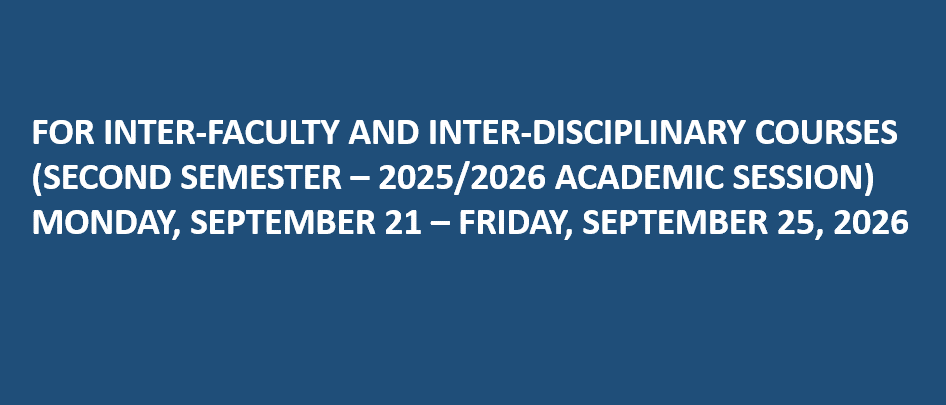
- Examination for Inter-Faculty and Inter-Disciplinary Courses
- Examinations in Inter-Faculty and Inter-Disciplinary Courses begin
- Examinations in Inter-Faculty and Inter-Disciplinary Courses end
- Faculty Boards meet to consider and approve Final Year students’ results
- Last date for submission of Final Year results to the Department and Processing Of Final Year results begins in December
- Last date for the submission of Final Year students’ results to the Registry (Examinations)
- Late registration begins
- Late registration ends
- Late registration ends for Freshmen
- Lectures begin
- Lectures end
- Lectures in progress
- Orientation of Freshmen begins
- Processing of Final Year students’ results ends in the Department
- Registration begins
- Registration begins for Freshmen
- Registration ends
- Senate meets to consider and approve Final Year students results
- Session Begins
- Students return to campus
- Teaching & Learning
- Academic Programmes
- Schools & Faculties
- Medical Sciences & Dentistry
- Anatomy
- Anesthesia
- Chemical Pathology
- Community Medicine
- Dermatology
- Hematology and Immunology
- Medical Microbiology
- Medical Biochemistry
- Medicine
- Morbid Anatomy
- Obstetrics and Gynecology
- Ophthalmology
- Otolaryngology
- Pediatrics
- Pharmacology and Therapeutics
- Physiology
- Psychological Medicine
- Radiation Medicine
- Surgery
- Medical Sciences Staff List
- Pharmaceutical Sciences
- Physical Sciences
- Post Graduate Studies
- Social Sciences
- Veterinary Medicine
- Animal Health and Production
- Veterinary Anatomy
- Veterinary Medicine
- Veterinary Obstetrics and Reproductive Diseases
- Veterinary Parasitology and Entomology
- Veterinary Pathology and Microbiology
- Veterinary Physiology/Pharmacology
- Veterinary Public Health and Preventive Medicine
- Veterinary Surgery
- Veterinary Teaching Hospital
- Faculty of Vet Medicine Staff List
- Environmental Studies
- Agriculture
- Arts
- Biological Sciences
- Business Administration
- Dentistry
- Education
- Engineering
- General Studies
- Health Sciences & Technology
- Health Administration and Management
- Medical Laboratory Sciences
- Medical Radiography and Radiological Sciences
- Medical Rehabilitation
- Nursing Sciences
- A SURVEY ON METHODS OF WEIGHT CONTROL AMONG FEMALE UNDERGRADUATE STUDENTS IN UNIVERSITY OF NIGERIA, ENUGU-CAMPUS
- ATTAINING GLOBAL SOCIAL INTEGRATION AND EQUITY THROUGH SPORTS FOR ALL
- Department of Medical Rehabilitation
- Faculty of Health Sciences Staff List
- Mr. Canice Chukwudi Anyachukwu
- THE RELATIONSHIP BETWEEN LIFESTYLES AND THE BODY MASS INDEX OF EXECUTIVES OFFCERS
- Law
- Medical Sciences & Dentistry
- Institutes
- University Campuses
- University Libraries
- Graduation Requirements
- Academic Calendar
- Innovation
- Life on Campus
- About the University
- Vision, Mission and Core Values
- From the Vice Chancellor
- Founding the University
- Through the years
- The University Lands
- Visitor Information
- Heroes
- Support Services Units
- School Anthem
- Office of the VC
- Testimonials
- University Staff Profile
- Student Information
- Frequently Asked Questions
- Contact Us
- News & Events
- Admission
![]()
Religion
BRIEF HISTORY OF THE DEPARTMENT
Originally called the Crowther College of Theology, the Department came into existence with the University in 1960, and, in keeping with the philosophy of the University, remains attached to the Faculty of the Social Sciences. This is in itself a notable distinction and the Department has emphasized the application of religious truth to the environment and its place in Nigerian society.
Its philosophy is one with that of the University: to restore the dignity of man. It is concerned with religious aspect of man in society, especially the black man in third world. Religion is studied in its three areas of expression in Nigeria: Judeo-Christian, African and Islamic.
It started with offering a B.A degree with emphasis in any two of the three stress areas. After the civil war it continued offering an initial degree (B.A) and later undergraduate diploma in Religious Studies and Postgraduate degree at Masters and Doctorate levels with emphasis on Christian Religious Studies. It became one of the service units in offering courses for regular and sandwich B.Ed. degree programmes in Education/ Religion. However, in 2005, the Diploma Programme was scrapped off the undertakings of the Department.
The Department has developed considerably over the years in terms of variety and levels of courses and programmes being offered. Some theological institutions are affiliated to the department namely, Trinity College, Umuahia, St. Paul’s College Awka; Wesley International Theological Seminary Lagos, and Spiritan Theological Seminary, Attakwu. The quality of teaching staff recruited has also considerably improved to meet the growth of the department, but the number of teaching staff needs improvement. The Department also offers Combined Honours degree in the following combinations; Religion and Cultural Studies/ Archaeology and Tourism, Religion and Cultural Studies/ English & Literary Studies, Religion and Cultural Studies/ History & International Relations, Religion and Cultural Studies/ Public Administration & Local Government, Religion and Cultural Studies/ Social Work, Religion and Cultural Studies/ Sociology & Anthropology.
PHILOSOPHY
Religion and Cultural Studies is a field of study integrating Judeo-Christianity & African Traditional Religion. In keeping with the philosophy of the University of Nigeria, the programme emphasizes the application of religious truth to the cultural environment of Africa. Students are exposed to the basic theological positions of Islam and other world religions with emphasis on Christianity and this enables man to understand his environment and hence able to master his destiny.
OBJECTIVES
The general objectives of the programme are to provide students with adequate knowledge, attitudes, values and skills generic to religion and cultural studies. Specifically the programme is drawn to provide students with basic methods of:
1. Interpreting the Bible and Christian tradition from an African perspective;
2. Explaining ethical relationship in a multi-religious society like Nigeria;
3. Delineating impartial approach towards the handling of religious concepts;
4. Resolving conflict from religious and Afro-cultural standpoints;
5. Handling problems and challenges of religious belief in a science–oriented environment;
6. Explaining the resilience and challenges of African Traditional Religious and Cultural belief in a Christian-dominated environment.
SCOPE
Religion and Cultural Studies Programme harnesses appropriate knowledge to incorporating students penchant and interest in the quality as well as cordial human relationship in a multi-religious and morally decadent society. It acquaints students with core contents of Christianity, African Traditional Religion and cultural practices, the basic content of Islam and Eastern Religions. The programme lasts for 3-4 years depending on entry qualification. The Programme is carefully structured to reflect adequately those required areas of knowledge, strengthening the rudiments of Judeo-Christianity and African Traditional Religion. Students are expected to learn the dynamics of religion in a multi-religio-cultural environment as Nigeria. Basic ethical demands in Afro-cultural environment are stressed. In the final year the programme is designed to apply Christian and African Traditional Religious beliefs to conflict resolution. The problems of Early Christianity and the resilience of African Cultural practices are highlighted.
ADMISSION REQUIREMENTS
There are two modes of entry into the programme subject to the candidate satisfying the University minimum entry requirements.
Applicants for admissions through UME must be holders of the Senior Secondary School Certificate Examination (SSSCE) or its equivalent with five credits including English Language and Christian Religious Knowledge.
For admission by Direct Entry (DE), candidates must have one of the following qualifications:
(a) Five GCE papers of which three must be credits in ordinary level and two passes in Advanced level including Christian Religious Knowledge.
(b) Holders of the 2-year Diploma from UNN or other approved Universities,
(c) A 3 year Diploma of recognized theological Institutions (admitted by Direct Entry for 3 year programme).
The Direct Entry requirement for candidates holding a University of Nigeria, Nsukka Diploma in Religion with not less than a merit Level Pass shall have credit level passes in GCE/SSCE (or their equivalents) in five subjects, which may or may not include Christian Religious Knowledge but with a credit in English Language.
JOB OPPORTUNITIES
Graduates of this Department have opportunities to undertake advance studies in disciplines associated with religious and socio-cultural studies. Consultancy and employment opportunities abound in Bible translation agencies locally and internationally for graduates of Religious and Cultural Studies. Graduates of this programme are also trained to work in corporate bodies, companies and institutions as Public Relations Personnel and other related opportunities which require high ethical principles, as well as in conflict resolution related outfits. With a degree in Religious and Cultural Studies, students gain analytical skills and ability to formulate and defend positions. Thus they are ideal candidates for pursuing a carrier in business and administration. Jobs more closely related to religious and cultural studies is Lay Minister/ Pastoral Caregiver, Counsellor, Community Advisor, Management Trainer, Customer Services Representative, Community Project Coordinator, Aid Organisation administrator, Government/ Institution Policy Analyst, Peace Corps Officer, Ministry of Arts and Culture. They can also engage in self-employment as consultants.
| STRESS AREAS | CODES | |
| Foundational Courses | 0 | |
| Old Testament | 1 | |
| New Testament | 2 | |
| Christian History and Doctrine | 3 | |
| Religion and Society | 4 | |
| African Traditional Religion | 5 | |
| Religious Ethics | 6 | |
| Islamic and Arabic Studies | 7 | |
| Seminar | 8 | |
| Project | 9 |